
HOME
ABOUT US
- About APVIA
- Organizational Structure
- Presidium of 5th Council
- Steering Committee
- Executive Committee
- Members
- Secretariat
- Contact Us
ANNOUNCEMENT
MEMBER SERVICES
NEWS CENTER
- Policies & Regulations
- Industry News
- Corporate News
- Market Updates
- Technology
- Expert Insights
- Project Information
EVENTS
- SNEC PV+
- SNEC ES+
- SNEC H2+
- RE+ Mexico
- Smart Energy Conference & Exhibition
- Int'l Workshop on Silicon Heterojunction Solar Cells
AWARDS
- About the APVIA Awards
- The 2025 APVIA Awards Ceremony Successfully Held
- APVIA Asia Photovoltaic Awards 2023 Ceremony Successfully Concluded!
- APVIA Awards 2021: List of Winners
- APVIA Awards 2019: List of Winners
- APVIA Awards 2017: List of Winners
- APVIA Awards 2015: List of Winners
- APVIA Awards 2013: List of Winners
Pledge
German researchers develop sodium-ion battery based on lignin

Image: Fraunhofer IKTS
Researchers from Germany's Fraunhofer Institute for Ceramic Technologies and Systems (IKTS) and the Friedrich-Schiller-University Jena have fabricated a prototype of a sodium-ion battery that uses lignin, a complex organic polymer found in the cell walls of plants, as electrode material.
Lignin is an abundant by-product of the wood and pulp industry. After processing, it exhibits good electrical conductivity, and its redox-active groups can reversibly store and release electrons. For battery applications, lignin is typically carbonized to produce hard carbon.
The research team used lignin supplied by Mercer Rosenthal GmbH, a German company specializing in the production of cellulose, bioenergy, and bio-based chemicals from wood and other renewable raw materials. The lignin was thermally converted into carbon under inert conditions and subsequently processed into negative electrodes.
“The structure of this hard carbon is very suitable for the reversible storage of sodium ions,” the academics explained. “Hard carbon boasts high electrochemical performance, good cycle stability and low acquisition costs, especially if obtained from sustainable raw materials.”
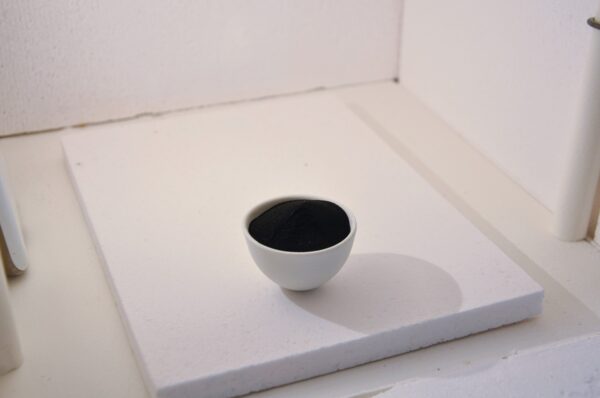
Hard carbon, obtained from lignin, a by-product from the wood industry, forms the basis for the electrode of the Thuringian Forest battery.
Image: Fraunhofer IKTS
Using this electrode material, the team assembled 1-Ah battery cells and tested them at the Fraunhofer IKTS battery test center in Arnstadt, at Fraunhofer IKTS in Hermsdorf, and at Friedrich Schiller University in Jena.
“After 100 charging and discharging cycles, the lab cell shows no significant degradation. The aim is to demonstrate 200 charging and discharging cycles for the 1-Ah full cell by the end of the project,” said the research's coordinator, Lukas Medenbach, noting that the proposed battery technology is intended for stationary or mobile storage applications.
More technical details about the new battery technology were not provided.
“The project aims to support increasing independence from critical raw materials while fostering the transition to cheaper, more sustainable and safe batteries,” Fraunhofer IKTS said in a statement. “It is being supported by an industrial advisory board consisting primarily of regional companies, including the Thuringia-based companies Mercer Rosenthal GmbH, Glatt Ingenieurtechnik GmbH, IBU-tec advanced materials AG and EAS Batteries GmbH, as well as Petrochemical Holding GmbH based in Vienna.”